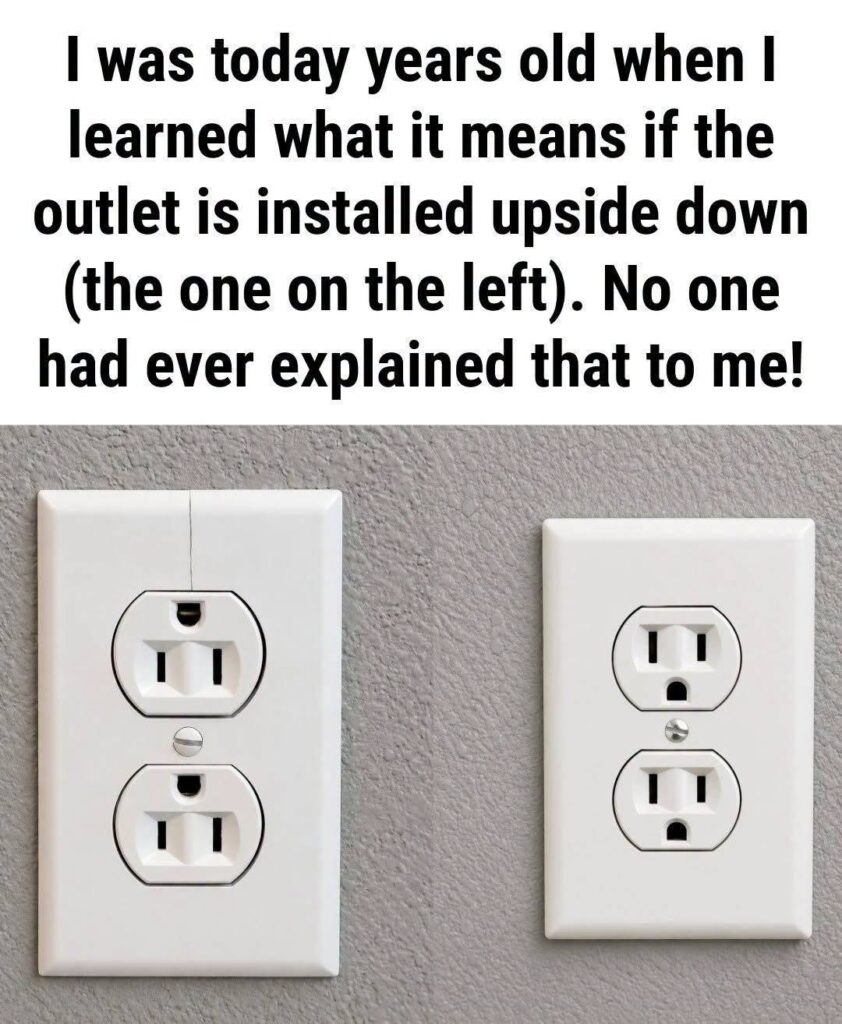
Why Do Some Electricians Install Outlets Ground-Up?
ADVERTISEMENT
Another reason you may see an upside-down outlet has nothing to do with wall switches.
Some electricians intentionally install outlets with the grounding slot on top because they believe it offers an additional safety advantage.
Here’s why:
ADVERTISEMENT
If a partially unplugged cord exposes the metal prongs and a conductive object—such as a paper clip or metal utensil—falls between the plug and the wall, it is more likely to contact the grounding pin first instead of the energized prongs.
Although this doesn’t eliminate electrical hazards, many professionals prefer this orientation, particularly in:
- Commercial buildings
- Hospitals
- Medical facilities
- Industrial environments
Residential homes, however, commonly use the traditional ground-down orientation simply because it’s what most homeowners expect.
Does Outlet Orientation Affect Safety?
The direction an outlet faces does not automatically determine whether it is safe or unsafe.
A properly installed outlet should include:
- Correct wiring
- Reliable grounding
- Secure electrical connections
- Proper circuit protection
- Compliance with local electrical codes
An outlet installed upside down can be just as safe as one installed in the traditional orientation.
Don’t Assume an Outlet Is Broken
One of the most common homeowner mistakes is assuming an outlet has stopped working when it is actually controlled by a wall switch.
Before replacing an outlet or calling an electrician:
- Check every nearby wall switch.
- Test both receptacles.
- Try plugging in a lamp instead of a charger.
- Verify whether another switch controls the circuit.
Many homeowners discover years later that a “dead” outlet was actually designed to operate a floor lamp.
Common Places to Find Switched Outlets
You’ll often find switched receptacles near areas where portable lighting is commonly used, including:
- Beside sofas
- Near beds
- Reading corners
- Living room walls
- Family rooms
- Home offices
These locations make it convenient to turn lights on or off without reaching for the lamp itself.
Power Strip Safety Tips
Whether your outlet is switched or always powered, it’s important to use power strips safely.
Follow these simple guidelines:
- Avoid plugging multiple high-power appliances into one power strip.
- Never connect one power strip to another.
- Replace damaged extension cords immediately.
- Keep cords away from heat and moisture.
- Use surge protectors for sensitive electronics.
- Do not overload electrical circuits.
Practicing good electrical safety helps reduce the risk of overheating and electrical fires.
Final Thoughts
An upside-down electrical outlet may look unusual, but in many homes it’s completely intentional. It often serves as a convenient visual clue that the outlet is connected to a wall switch, although this isn’t a universal rule.
Because outlet orientation varies between electricians and local building practices, the only reliable way to know whether an outlet is switch-controlled is to test it safely with a lamp.
Understanding these small details about your home’s electrical system can make everyday life more convenient while helping you avoid unnecessary repairs or confusion
Frequently Asked Questions
Why is my electrical outlet upside down?
It may indicate a switch-controlled outlet, reflect the electrician’s preferred installation method, or simply be the result of a previous replacement.
Is an upside-down outlet dangerous?
No. When properly wired and installed according to electrical codes, an upside-down outlet is just as safe as a traditionally installed outlet.
How can I tell if my outlet is controlled by a switch?
Plug in a lamp, turn it on, and operate nearby wall switches. If the lamp turns on and off, the outlet is switch-controlled.
Why do commercial buildings often use ground-up outlets?
Many electricians believe the ground-up orientation provides an extra level of protection if a metal object accidentally contacts a partially unplugged plug.
Should I change an upside-down outlet?
Not unless there’s a functional reason or an electrical issue. The outlet’s orientation alone does not affect its performance or safety.
ADVERTISEMENT