ADVERTISEMENT
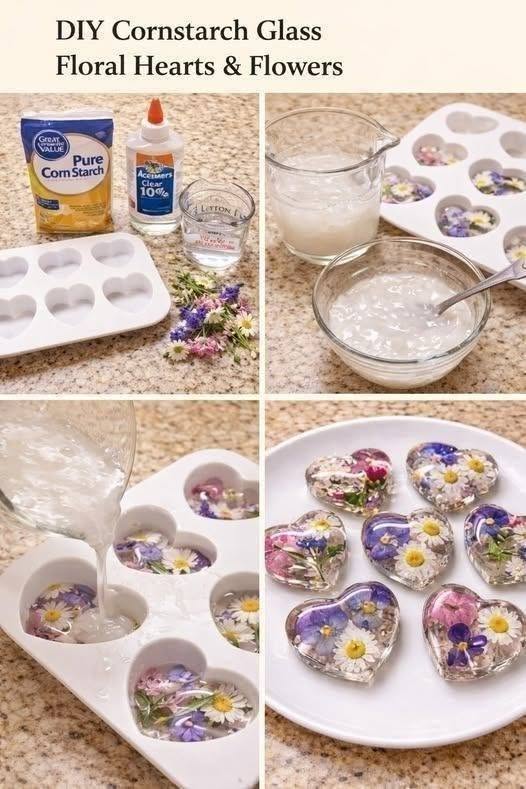
At first glance, these delicate creations look like something found in an artisan boutique—translucent hearts and flowers in soft jewel tones catching the light like genuine pieces of colored glass. In reality, they are handmade ornaments crafted from nothing more than cornstarch, baking soda, water, and a touch of food coloring.
This cornstarch glass dough produces beautiful, sea-glass-like results from simple materials. The process yields a smooth, frosted finish that diffuses light, making the finished pieces perfect for displaying in sunny windows, hanging as holiday ornaments, or stringing together into decorative garlands.
Ingredients & Tools
The Ceramic-Mimic Dough
-
Cornstarch: 1 cup (the primary structural foundation delivering a fine-textured, smooth surface)
-
Baking soda (sodium bicarbonate): 1 cup (moderates texture, prevents cracking, and adds a soft frosted-glass look)
-
Filtered water: ¾ cup
Equipment & Finishing
-
Food coloring: Liquid or gel tints (soft pastel pink, turquoise, and lavender deliver the most convincing stained-glass effect)
-
Cookie cutters: Heart, flower, or geometric shapes
-
Parchment paper: 2 large sheets (essential for rolling and drying without sticking)
-
Stovetop essentials: Medium saucepan and a heavy wooden spoon or silicone spatula
-
Perforation tool: A drinking straw or toothpick to punch hanging holes
-
Optional enhancements: Fine iridescent glitter, metallic gold leaf paint for edge-gilding, ribbon or twine, and clear Mod Podge or acrylic craft sealant
The Chemistry of Starch Gelatinization & Translucency
-
The Gelatinization Network: Raw cornstarch consists of tightly packed crystalline starch granules. When mixed with water and heated to approximately 144°F to 158°F (62°C to 70°C), the starch granules absorb water, swelling extensively until they burst. This releases amylose and amylopectin molecules into the liquid, forming a continuous, pliable hydrogel polymer network.
-
The Matte Glass Optical Illusion: As the sculpted shapes air-dry over 24 to 48 hours, water completely evaporates from the hydrogel, forcing the starch and fine baking soda molecules into a uniform, high-density matrix. Because this solid matrix allows light waves to pass through in a diffused state, it perfectly mimics the optical properties of frosted sea glass.
-
The ¼-Inch Thickness Rule: Keeping the rolled dough at exactly ¼-inch thickness is critical. If the shapes are cut thicker, light waves cannot pass through, making the ornament completely opaque. If cut thinner, structural integrity drops significantly, causing the shapes to warp, curl, or crack as the moisture evaporates.
Step-by-Step Instructions:
ADVERTISEMENT
See more on the next page to continue reading →
ADVERTISEMENT